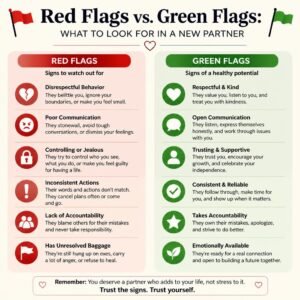
When you’re getting to know someone new, it’s easy to focus on chemistry, attraction, and fun moments. But beneath the surface, small behaviors can signal whether this person is likely to be a healthy, supportive partner—or someone who will drain your energy and undermine your well-being.
Learning to recognize red flags (warning signs) and green flags (positive indicators) early can save you time, heartache, and emotional damage. Here’s what to look for—and what to do when you see it.

What Are Red Flags and Green Flags?
- Red flags are behaviors or traits that suggest potential problems: disrespect, control, inconsistency, or emotional unavailability. They don’t always mean “run immediately,” but they deserve attention and often require a conversation or boundary.
- Green flags are signs of emotional health, respect, and compatibility: good communication, kindness, reliability, and shared values. They show that someone is likely to be a safe, supportive partner.
Think of flags as patterns , not one‑off incidents. A single bad day isn’t a red flag; repeated behavior is.
Common Red Flags in a New Partner
1. Disrespectful or Dismissive Behavior
How they talk to you—and about others—matters.
Example:
- Interrupting you frequently or talking over you
- Mocking your interests, opinions, or feelings
- Making jokes at your expense that feel hurtful
- Speaking negatively about exes in extreme ways (“They were all crazy”)
Why it matters:
Respect is the foundation of a healthy relationship. If someone dismisses you early on, it rarely improves over time.
2. Controlling or Possessive Tendencies
Watch for subtle attempts to limit your independence.
Example:
- Questioning who you spend time with or where you go
- Getting upset when you have plans without them
- Pressuring you to change your appearance, hobbies, or friendships
- Checking your phone or social media without permission
Why it matters:
Control often escalates. Early possessiveness can turn into isolation or emotional abuse.
3. Inconsistency and Unreliability
Words and actions should match.
Example:
- Frequently canceling plans last‑minute with weak excuses
- Saying they’ll call or text and then “forgetting” repeatedly
- Hot‑and‑cold behavior: intense attention one day, distant the next
- Making big promises (“I’ll introduce you to my friends”) that never happen
Why it matters:
Consistency builds trust. Inconsistency creates anxiety and uncertainty.
4. Poor Conflict Skills
How someone handles disagreement is revealing.
Example:
- Shutting down, walking away, or giving the silent treatment
- Blaming you for everything (“You made me angry”)
- Refusing to apologize or admit mistakes
- Escalating small issues into arguments
Why it matters:
Conflict is inevitable. If they can’t handle it respectfully now, it will only get harder later.
5. Disregard for Your Boundaries
Boundaries are about safety and comfort.
Example:
- Pressuring you physically or sexually after you say no
- Ignoring your requests (eg, “Please don’t call after 11 pm”)
- Getting defensive when you express a need or concern
- Making you feel guilty for having limits
Why it matters:
A partner who respects your boundaries respects you as a person.
Common Green Flags in a New Partner
1. Good Communication and Active Listening
They show genuine interest in what you say.
Example:
- Asking follow‑up questions about your stories
- Remembering details you’ve shared
- Checking in on how you’re feeling
- Sharing their own thoughts and feelings openly
Why it matters:
Healthy relationships thrive on clear, respectful communication.
2. Kindness and Empathy
Look for how they treat you—and others.
Example:
- Speaking respectfully to waitstaff, colleagues, and strangers
- Showing concern when you’re stressed or upset
- Offering support without being asked (“Can I help with that?”)
- Celebrating your successes, not competing with them
Why it matters:
Kindness is a choice. Someone who consistently chooses it is more likely to be a supportive partner.
3. Reliability and consistency
They do what they say they’ll do.
Example:
- Showing up on time and prepared
- through on plans and promises
- Communicating clearly if something changes
- Being emotionally steady rather than dramatically up and down
Why it matters:
Reliability builds security. You feel you can count on them.
4. Respect for Your Independence
They encourage you to have your own life.
Example:
- Supporting your friendships, hobbies, and career goals
- Not getting jealous when you spend time with others
- Encouraging you to take time for yourself
- Trusting you without constant checking or questioning
Why it matters:
A healthy partner wants you to thrive, not just revolve around them.
5. Shared Values and Healthy Conflict
You don’t need to agree on everything, but core values should align.
Example:
- Similar views on honesty, family, money, or long‑term goals
- Willingness to discuss differences calmly
- Ability to compromise without resentment
- Apologizing sincerely when they’re wrong
Why it matters:
Shared values create a strong foundation. Healthy conflict skills keep the relationship resilient.
How to Use This Information
1. Observe Over Time
One incident isn’t a pattern. Pay attention to:
- How they behave when stressed or tired
- How they talk about past relationships
- How they respond when you say no or set a boundary
2. Trust Your Feelings
If you often feel:
- Anxious before seeing them
- Confused about where you stand
- Like you’re walking on eggshells
…those are internal red flags, even if you can’t name the behavior yet.
3. Talk About What You See
If you notice a red flag:
- Name it calmly: “I’ve noticed you often cancel plans last‑minute. That makes it hard for me to feel I can rely on you.”
- See how they respond. Defensiveness or blame is another red flag. Willingness to listen and adjust is a green flag.
Final Thought: Flags Are Guides, Not Verdicts
Red flags don’t automatically mean “end it,” but they do mean “pay attention.” Green flags don’t guarantee a perfect relationship, but they increase the odds of a healthy one.
By learning to recognize both, you can move through dating with more clarity and confidence—choosing partners who add to your life, rather than subtract from it.
what to do when your partner has a date, what to do when your partner goes on a date, partner art, partner yoga, ideal partner, art dates, partner yoga flow, partner yoga poses, date, money date, better date than never, surprise your partner, date night dinner, learn to date, never been on a date, partner yoga for couples, date night in paris, painting date, partner yoga for beginners, partner painting challenge, blind date, first date, date night, date idea for introverts, date ideas, date ideas winter, date ideas for teenagers, first dates rtl+